FIRST LOOK: 2027 RANGE ROVER EV BOASTS 531-KM RANGE
“First and foremost, it will be a Range Rover.” If I had a pound sterling for every time I heard that during a recent assignment in the U.K. for the global reveal of the first-ever all-electric Range Rover, I’d be able to buy a nice steak pie and a pint or two at the local pub. I heard that refrain from not just Range Rover product specialists during the deep-dive workshops, which shouldn’t be a surprise, but also from the off-road guide during a Defender Octa ride at the automaker’s legendary off-road facility on the Eastnor Castle estate; from a greeter at JLR’s Electric Propulsion Manufacturing Centre in Straffordshire; and even from the shuttle driver who picked me up at Heathrow to deliver me to the event hotel in Stratford-upon-Avon.
In today’s parlance, that’s called “being on-brand,” and it coincides with Range Rover’s mandate of putting an “emphasis on building brand, not vehicles.” But of course, the vehicles are what define a brand. And from what we’ve learned, the initial all-electric Range Rover is very much on-brand, from its appearance inside and out; to its performance attributes; to its off-road capabilities, the latter of which we experienced, albeit briefly, in the driver’s seat. Here’s what we came away with.
What is the 2027 Range Rover EV?
The 2027 Range Rover EV, and the soon-to-follow Range Rover Sport EV , is an all-electric version of the automaker’s flagship SUV . It is based on JLR’s Modular Longitudinal Architecture (MLA), developed 11 years ago to underpin both gas- and battery-powered vehicles. In addition to allowing for a variety of fuels, the architecture allows for standard- and long-wheelbase vehicle applications, and provides increased rigidity. More specifically, the new Range Rover EV rocks the stiffest chassis of any Range Rover to date.
The MLA also allows for an 800-volt electrical system, and accommodates larger battery packs over 110 kWh. According to Range Rover, the time-frame from conception to reality of the new EV was five years.
How do the gas and electric Range Rovers differ?
While the powertrain underpinnings obviously differ between the gas and electric Range Rovers, inside, they are all but identical “from the carpet up.” There are a couple of exterior differences, though: the EV’s aero grille, while designed to look much like the gas model’s, is blanked out, as there is no need for airflow to cool an engine; and the EV gets aero wheels.
While it’s a bit of an oddity for an all-electric SUV to have a transmission tunnel — the advantage of not having one being a completely flat cabin floor and a more spacious interior — the Range Rover EV’s is utilized to store battery electronics. One benefit of that is the space under the bonnet — when in England, and all — is freed up for a frunk, which the Range Rover does indeed have.
The EV model is 165 lbs (75 kg) heavier than the gas version. Another slight difference is that the electric variant sees its centre of gravity lowered 88 mm (3.5 inches), all the better for driving dynamics. The all-electric gets an upgrade in suspension over the base Range Rover V8, getting the Sport SV’s terrific twin-chamber set-up. Other than that, the two share all the same attributes in terms of onboard safety systems, and the same 7.3-degree rear-wheel steering.
What powers the 2027 Range Rover EV?
Range Rover is known for robust powertrains, and that certainly is the case in the new Range Rover EV. All the batteries, electric drive units (EDUs), and drive units were developed in-house, underscoring JLR’s commitment to the EV segment. The 240-kW EDU is 24% more efficient than the Jaguar I-Pace’s EDU, and fed by the 118-kWh battery pack that generates 550 horsepower and an off-roading-friendly 627 lb-ft of torque .
As to range, official estimates are an impressive 531 kilometres . One unique aspect of the electric system is a double-stacked battery design, necessary for the pack to fit into the MLA platform. The battery pack will be monitored digitally 24/7 to troubleshoot issues.
Electrical charging of the 2027 Range Rover EV
As mentioned, the Range Rover EV uses 800-volt architecture , which according to the automaker means a 10% to 80% charge time of 22 minutes, or 320 kilometres added in 15 minutes using a DC charger (with the usual “under ideal circumstances” caveat in both cases). As to Level 2 charging, there’s a robust 22-kW output said to charge from near-zero to full in approximately seven hours. There’s an NACS (Tesla-style) charge port located at the rear of the passenger side, with dual ports available as an option; and a 7.5-metre charge cord, which is logical as this is a five-metre-long vehicle. A vehicle-to-load (V2L) ability will be available in the first arrivals, with vehicle-to-grid (V2G) to follow.
Driving dynamics of the 2027 Range Rover EV
We only had about 10 minutes or so of seat-time in the Range Rover EV, and that was on a closed off-road course (look for our full first-drive account from Scotland in late October). According to Range Rover, the EV has a zero-to-96-km/h (-60-mph) sprint time of 4.3 seconds, and the V8 model was used as the benchmark for power and handling. Like the gas model, there are five drive modes; however they have all been recalibrated for an EV, and include one-pedal driving. There is no manual regenerative-braking feature; instead, specific regen levels are set depending on which drive mode the vehicle is in.
Off-roading capability of the Range Rover EV
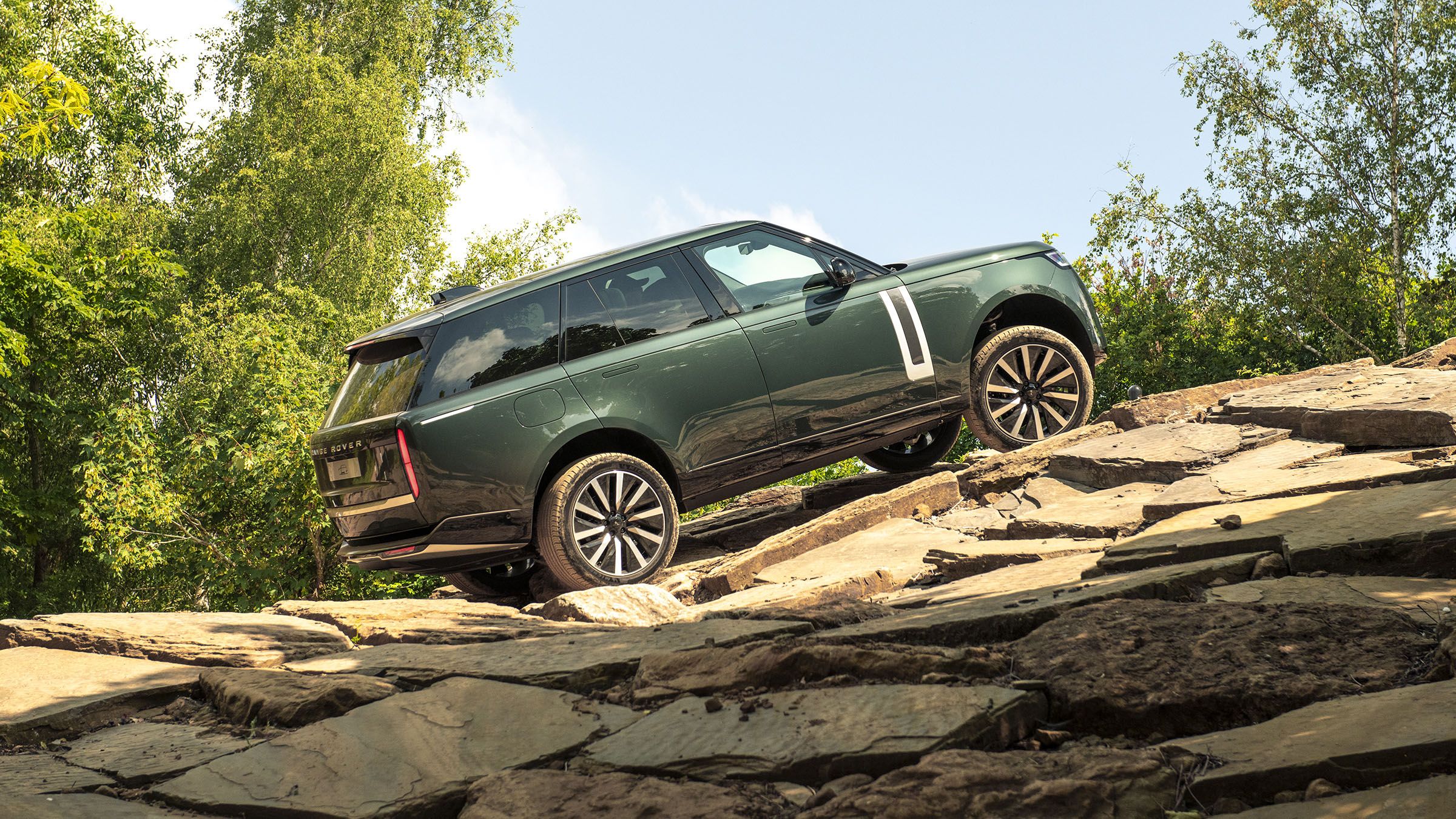
The first time I ever had a true go at some serious off-roading or rock-climbing in a Range Rover was at the launch of the 2018 Sport, and I was blown away by its capabilities. Well, in the short loop that I piloted the new all-electric version – which included a climb up a rocky and steep incline – I can say with confidence, “first and foremost, this is a Range Rover.”
The numbers tell the story: a 45-degree rolling climb; 33.2-degree approach angle; 28.1° departure angle; and a 35.4-inch (900-mm) wading depth, the same as the V8 model. What isn’t the same as the V8 is the traction-control speed adjustment, which the company claims is 100 times(!) faster in the EV. Also, since the all-electric has just one gear, there is no need to put it in low gear when you engage Rock Mode. An interesting stat that Range Rover provided found that while 40% of owners say they off-road their vehicle, company research shows that that number is actually closer to 10%. Perhaps some of them thick speed bumps at the mall qualify.
What is the target market for the 2027 Range Rover EV?
Range Rover did extensive customer-feedback research on what an all-electric Range Rover should be, and the overwhelming sentiment was, to paraphrase, don’t change the feel or vibe of the gas model, just make it better. The company reports there are 80,000 so-called “hand-raisers” interested in the Range Rover EV — half of those in North America — with 70% of those new to the brand, and 20% already EV owners. According to the company, 40% of current Range Rover owners use their vehicle to tow, so the EV is rated at 5,511 lbs (2,500 kg).
How much will the Range Rover EV cost, and when will it be available in Canada?
We expect the 2027 Range Rover EV to start arriving in Canada in the first quarter of 2027, and we should know more about pricing in the coming months.
Sign up for our newsletter Blind-Spot Monitor and follow our social channels on X, Tiktokand LinkedIn to stay up to date on the latest automotive news, reviews, car culture, and vehicle shopping advice.
2026-09-01T23:43:24Z